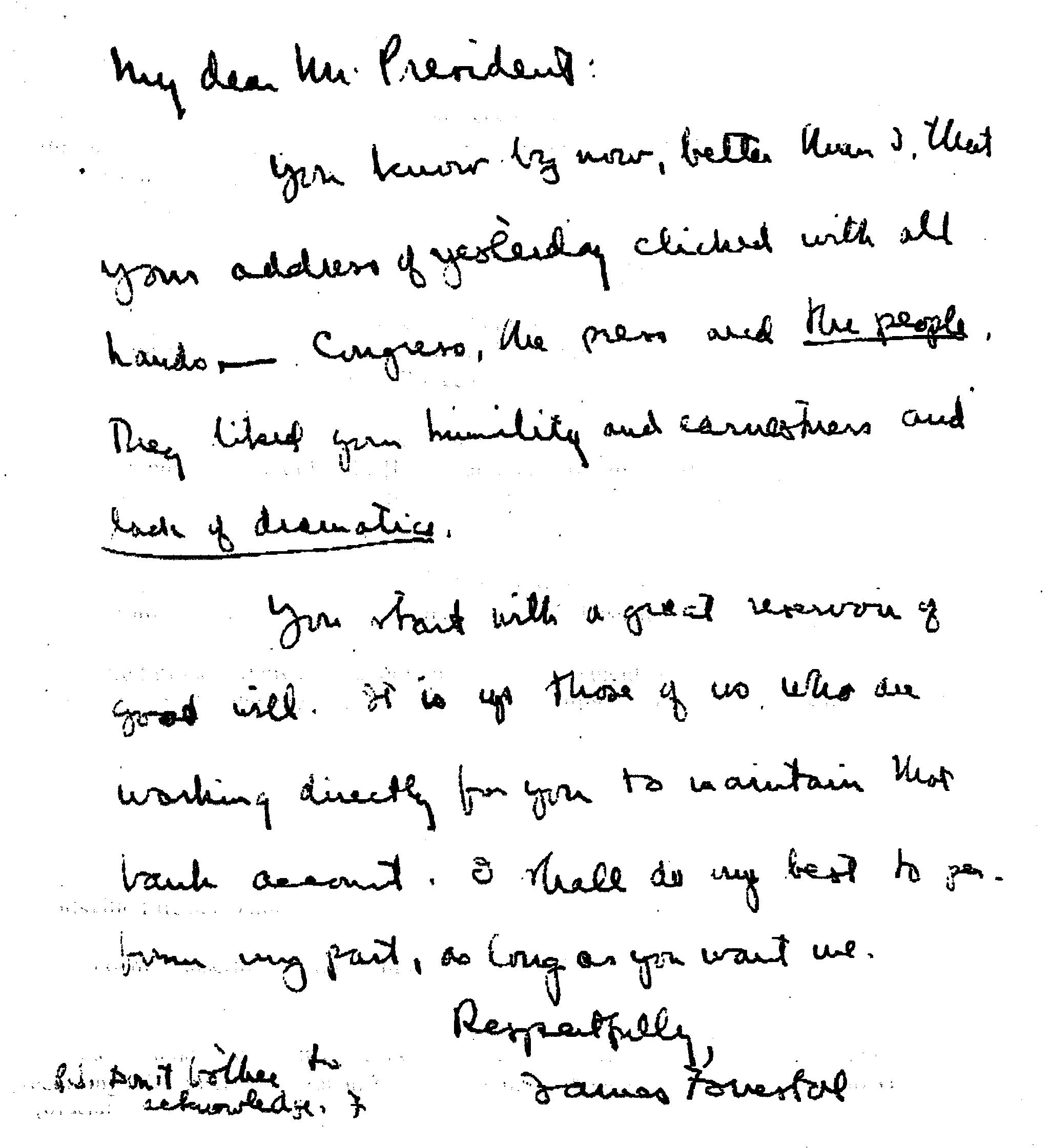
Handwriting
Tells Dark Tale?
By Hugh Turley
As Americans are killed and wounded daily in the Middle East the public
might well revisit the May 22, 1949, death of James V. Forrestal, the first
Secretary of Defense of the United States.
Forrestal cautioned that U.S. oil supplies could be endangered,
relations with Middle East nations could be strained, and a possible military
entanglement in the region could result from U.S. support for the partitioning
of Palestine and sponsorship of Israel in 1948.
In the opinion of biographers Townsend Hoopes
and Douglas Brinkley (Driven Patriot, the Life and Times of James Forrestal,
1992), Forrestal’s position on the Middle East was motivated by his concern for
basic national interests. He thought it was wrong for his Irish immigrant
father’s emotional ties to the Old Country to color his politics, and he viewed
many Middle East partisans in the United States similarly.
Initial news reports on Forrestal’s death said it was a “suicide” caused
by depression. As evidence that he was depressed, they said
Forrestal was copying a morbid poem, "Chorus from Ajax" by
Sophocles, just before he plunged from the 16th floor window of the
Bethesda Naval Hospital.
Historic Document Now Available At Princeton
Although Forrestal died in 1949 the official report on his death, known
as the Willcutts Report after Admiral Morton D. Willcutts, the head of the National Naval Medical Center,
was not available to the public until 2004.
The Hyattsville Life and Times found the handwritten poem in the Willcutts Report at the Seeley G. Mudd
Manuscript Library of Princeton University. In the testimony, the
poem is mentioned only once: “Is that the [poem] he copied? It
looks like [Forrestal’s] handwriting,” Captain George N. Raines said.
For comparison, the Hyattsville Life & Times obtained samples of
James V. Forrestal’s handwriting from the Harry S. Truman Presidential
Library. (See poem transcription and Forrestal note as shown in original hard copy of this
article. ed.) Noting the obvious differences in
the writing style, the documents were forwarded to Professor Karen Miller
Russell of the University of Georgia College of Journalism. Professor
Russell has researched and written about the media and Forrestal.
“Allow readers to determine the truth for themselves” [with respect to
the transcription’s authenticity], Professor
Russell said.
The origin of the story that Forrestal copied the poem is remarkable
because there were contradictory accounts in the Washington Post on May 23,
1949. One story reported the poem was in his handwriting and stopped in
the middle of the word ‘nightingale,’ in the second stanza. Another
story, in the same edition, reported he wrote in a firm and legible handwriting
lines that did not come until much later, near the end of the poem.
The official copy of the poem from the Princeton Library ends 11 lines
before the line with the word “nightingale” so initial newspaper accounts appear
to be false.
Fifty years later, the Washington Post was still publicizing the poem as
indicative of Forrestal’s suicidal emotional condition. A front-page
article in the Sunday Style Section on May 23, 1999, featured photos of the
Naval Hospital, the 16th floor window, and a book open to the poem. The
article began by describing how Forrestal’s hand moved across the paper copying
Greek poetry from a thick anthology.
The Willcutts Report, the government’s last
official word on the matter, concluded:
“… The late James V. Forrestal died about 1:50 A.M. on Sunday, May 22,
1949, at the National Naval Medical Center, Bethesda, Maryland, as a result of
injuries, multiple extreme, received incident to a fall from a high point in
the tower, Building 1.” It did not say what caused the fall and it did
not call the death a suicide.
John Spalding of Littlestown, Pa., 87, was a Navy enlisted man and
Forrestal’s personal driver. When Forrestal died,
Spalding was called down to Admiral Monroe Kelly’s office, “He had a big
map and he said where do you want to go for duty…You are going to leave
tonight,” Spalding told the Hyattsville Life & Times.
Spalding decided to go to Guantanamo, Cuba, but before he left, Admiral
Kelly and his aide Lt. Hooper made him sign a paper saying that he would never
talk about anything regarding Secretary Forrestal.
Spalding said that, in his presence, Forrestal never appeared depressed,
paranoid, or in any way abnormal.
If
a Vietnam style memorial is ever erected to commemorate Americans dying in the
Middle East, the name of the man who warned our current military entanglement
might well be listed as the first casualty.
This
article first appeared in the December 2007 Hyattsville Life and Times.
It is reprinted here with their permission.
January 30,
2009
Home Page Column
Column 5 Archive Contact