Lying About Bombing
On Monday, February 14, a very powerful bomb in
Beirut killed former Lebanese prime minister, Rafiq
Hariri and 13 other people. No evidence has been produced as to who might
have placed the bomb. That did not stop the major American news media
from pointing the finger of suspicion at the government of Bashar Assad of
Syria, even as they were reporting the news of the tragedy, and the United
States government has withdrawn its ambassador from Syria in “retaliation,” as
if Bush and company were certain that Syria was to blame.
On Wednesday, February 16, the “liberal opposition”
newspaper, The Washington Post,
surged to the front of the pack of hounds baying for strong measures against
Syria with a lead editorial entitled, “Murder in Beirut.”
“The despicable murder of Mr. Hariri benefits no
one outside the rogue regime in Damascus—and the world should respond
accordingly,” it said. “If the assassination of Mr. Hariri—the most
plausible leader of a truly independent Lebanon—looks like the panicked
act of a cornered tyrant, the shoe snugly fits Mr. Assad.”
But should we really take on faith what we are told
by American government leaders and the likes of The Washington Post when it comes to shadowy political
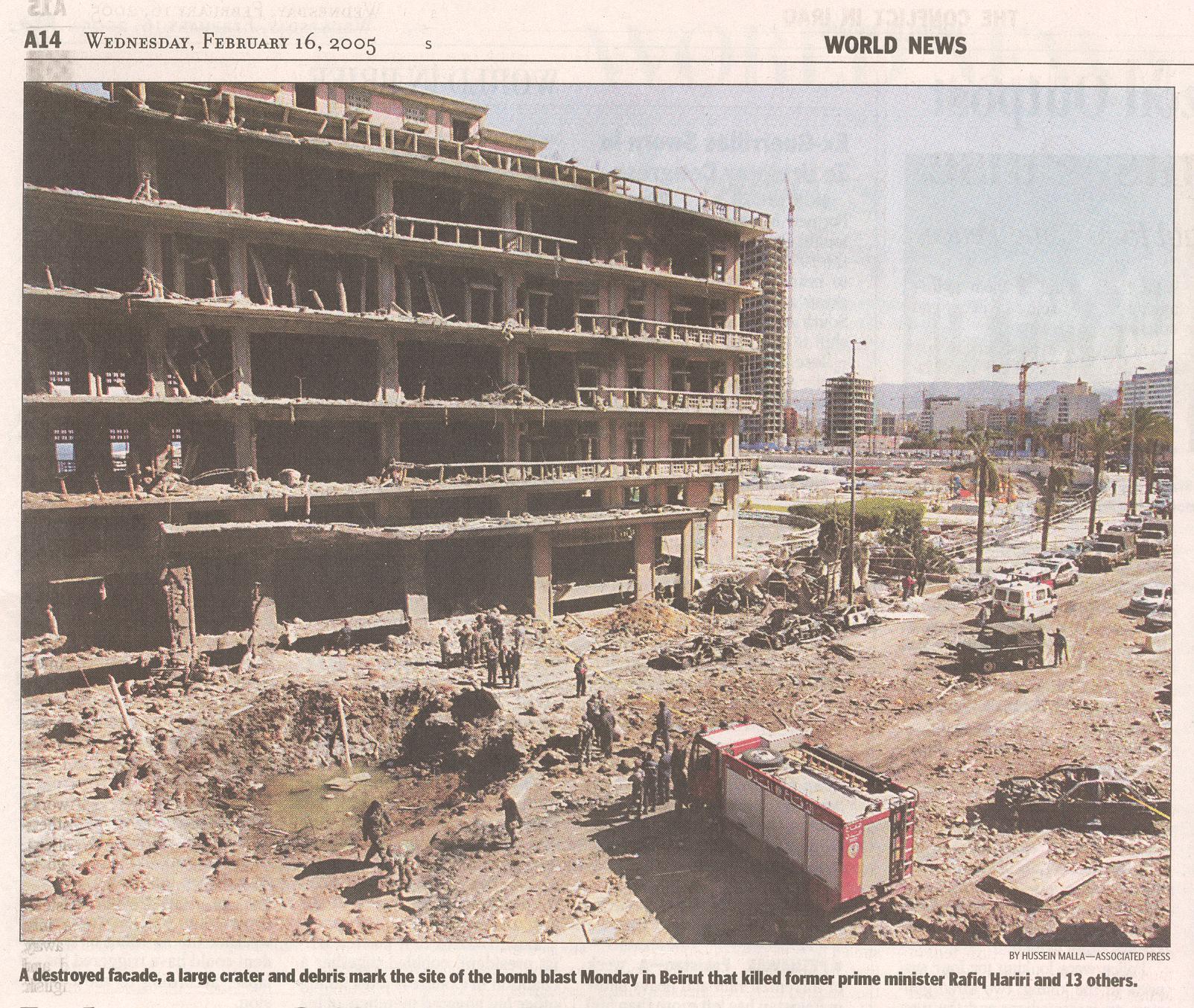
bombings? An Associated Press article on the effects of the Beirut bomb published
in that same issue of The Washington Post,
on page A14 suggests very strongly that we should not. Notice the damage
that was done to the building that faces the street where the bomb exploded,
leaving a massive crater. The entire façade of the building is stripped
away, but all the support columns remain standing. The same thing
occurred when the Khobar Towers building, housing
U.S. military personnel in Saudi Arabia, was bombed.
Recall now that the United States government and
the American news media want us to believe that a similar bomb out in the
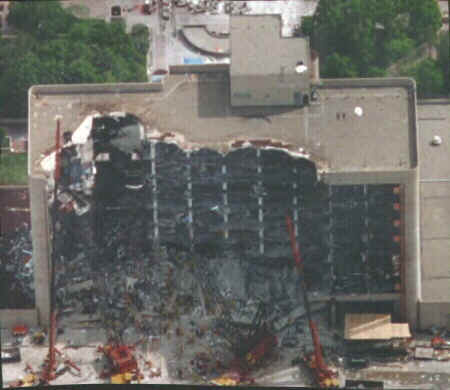
street in front of the building caused all the damage to the Murrah Building in Oklahoma City. But as we look at
that damage, we see that a large section of the Murrah
Building was gouged out, caused by the collapse of not just front
row support columns, but by others farther back in the building. The
collapsing columns, as we can see from the photograph, were also considerably
farther from the street blast than were several others.
In 1995, retired Air Force weapons
expert, General Benton Partin, told us that the
damage to the support columns of the Murrah Building
could not possibly have resulted from a bomb in the street of the size of the
one that blew up the Ryder truck. Air, he pointed out, is a great
absorber of energy, and by the time the blast wave reached the columns it would
exert only a tiny fraction of the force needed to cause any of them to
fall. His argument made sense at the time, but The Washington Post was among those who made sure that not many
people heard it. The picture they have now published of the fateful bomb
in Beirut virtually proves that General Partin was
right. The Post and the
government lied to us about what happened in Oklahoma City. Should we
trust them over what happened in Beirut?
David Martin
February 21, 2005
Home Page Column Column 4 Archive
Contact